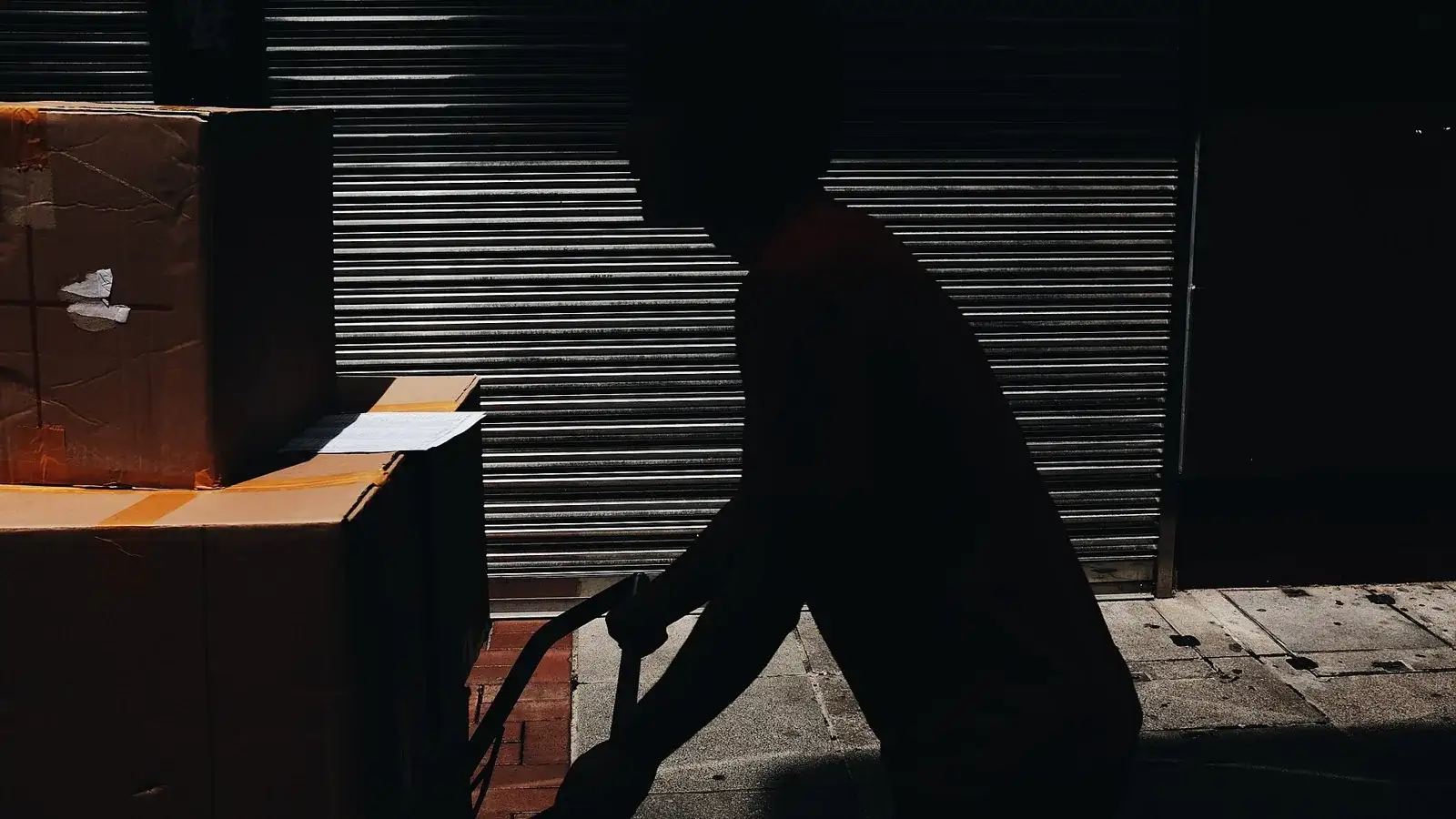
Sorting the Purchased
Late evening, the last week of the month, a finger above the Buy button. A few days later a person walks through the apartment sorting things bought for a better version of himself, and the measure he applies to them turns, in the end, on him.
maique madeira / Unsplash · CC0
The worth of a thing is set by the purpose of the one sorting it. Without a purpose there is nothing to sort against, and the button sells someone else's purpose along with itself.
Contents
Finger over the button
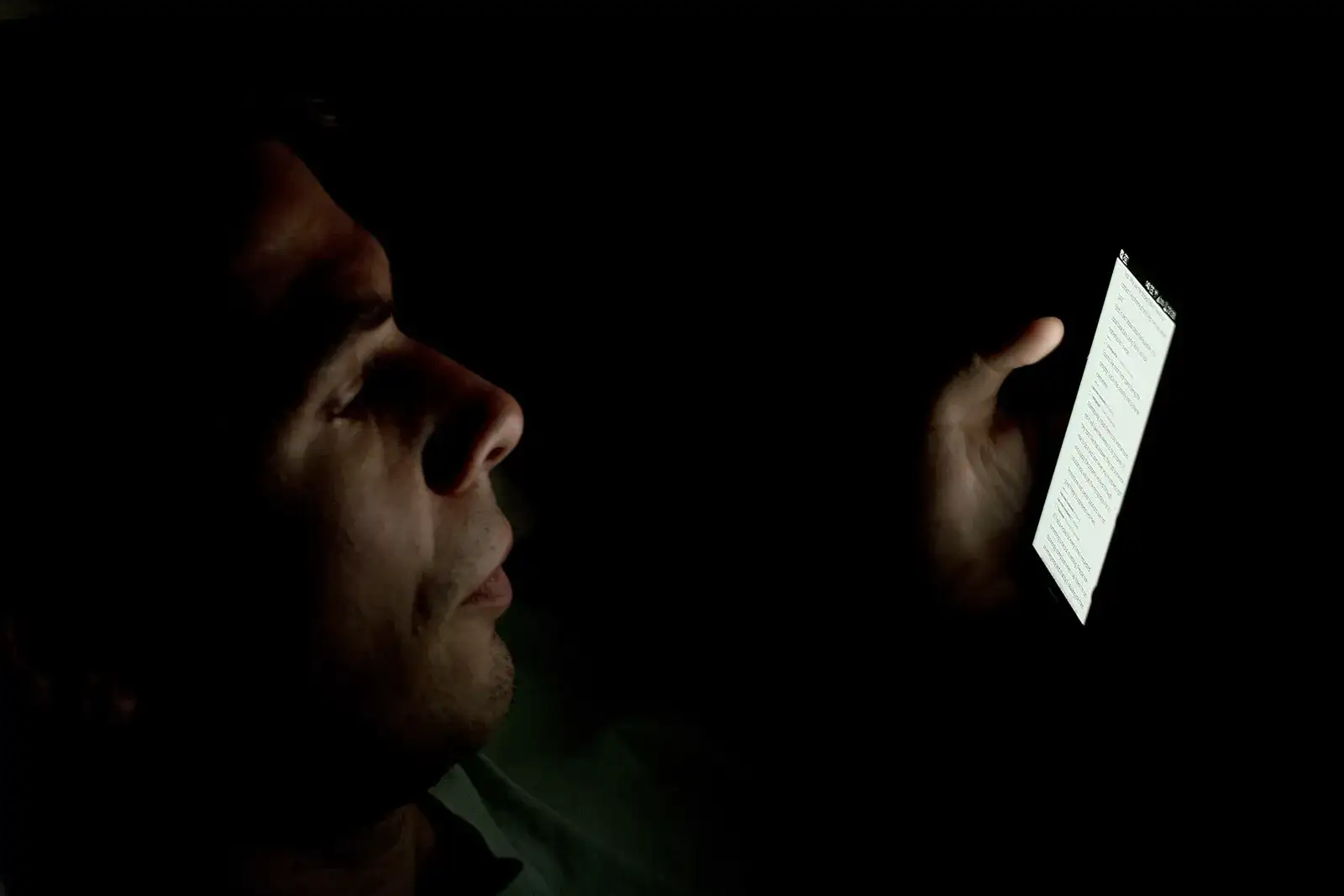
In the evening he begins to unpack the box. His finger rests above the button. The light from the screen falls on his face, and in the dark room all that can be seen is this patch of light and a hand frozen halfway. As the month reaches its final week, the page holds out another way of living: composed, calm, with a clean morning and even breathing. The price is two days of his work, and he counts them in shifts: two full days, eight morning alarms, sixteen hours at the machine or at a desk. The month is already mapped out, and those two days were meant for the rent, for groceries, for something quiet and obligatory that does not glow in the dark and promises nothing except that the month will close without holes. But the finger comes down. The press is soft, almost inaudible, and the screen flashes confirmation. Done. Now the apartment will hold a thing that was supposed to lift life one step higher.
A few days pass. The purchases are scattered across the rooms, and he walks among them with hands that, for the first time in a long while, hold nothing. In the evening, when work is over and the lights are on, he starts sorting through them. Cleaning has an order you know in advance: dust, floor, dishes; but here there is no order, and it has to be extracted from each object separately. He picks up the first item. Noise-canceling headphones, still in their wrap, the box unopened. He turns it over, looks at the transparent plastic, at the cellophane seam under his finger. A promise of silence, bought on a noisy day. They’ve been lying there for a week now. His hand sets the box on the table and reaches for the next thing.
In the kitchen stands the coffee maker. Next to the button, fingerprints darkened with coffee grounds, and this is the only object he doesn’t have to evaluate. It has already entered the day: morning begins with its hum, with steam over the cup, with a smell that wakes him before the alarm. It has a past in his hands, and that past is daily, small, habitual. He walks around it and moves on. A Japanese kitchen knife lies on the board, the blade already slightly darkened from onion, but the handle settles into his palm as if the hand itself knows where it belongs. These objects get decided quickly: what has entered the day stays. What promised to change the day but never touched it remains in question.
In the corner of the living room stands a warm-light lamp, unopened. He lifts the box, weighs it, sets it back down. This is the object where the sorting stops. It has no past, only the future it was meant to create. Warm light for evenings that were meant to become calmer. But the evenings pass, and the light in the room is still cold, overhead, the same as before the purchase. He stands over the box and doesn’t know what to do with it. The question lies beyond the lamp: does he even want those evenings it was meant to illuminate.
Poverty deeper than the account
The poverty of 2026 has almost nothing to do with the amount in one’s account. It lives deeper. It starts from knowing how little command one has over one’s own existence, and the bare table plays no part in that feeling. The rent is paid, there is food, but the reserve is thin, and every decision about money weighs with who you feel yourself to be. The World Bank calculated in 2025: In low- and middle-income countries, about 55 percent of adults would be able to raise extra money in an emergency or get by for two months if their main source of income stopped.7 Almost half answer no. The U.S. Federal Reserve, in its 2024 report, offers its own figure: For an unexpected 400-dollar expense, 63 percent of Americans would have cash or an equivalent ready.3 More than a third answer no. It is on this threshold that the button sells best. The thing remains a thing, but what it sells is a step upward, the feeling that control is returning, that life can be assembled with one’s own hands, one object at a time.
The future has become short. When the horizon shrinks to the end of the month, an object that promises a future seems like a way to buy one. And here a mechanism appears that makes this possible even when there is no money. The National Bank of Ukraine, in its December 2024 financial stability report, records: Over the year, the net hryvnia credit portfolio of households expanded by over 30 percent.6 The same Federal Reserve report adds: 15 percent of Americans used buy-now-pay-later services in the previous 12 months, compared with 10 percent in 2021.4 A price split into installments sells a short future twice. The month that lacked money now owes the coming months as well. But this arithmetic sounds from far away, and in the apartment stands a person with a box in his hands, and his question about percentages stays somewhere behind, because it is really about what to keep and what to send back.
Sorting and easy decisions
The sorting begins with easy decisions. The headphones in their wrap go into the returns bag: a promise without a past, without a single day of use, without a trace in his life. The coffee maker stays. The knife stays. Seneca wrote in Letter 71: when a man does not know which harbor he is heading for, no wind will be favorable.1 Daily use works as a harbor that lets you assess what has a past. Yet something acquired solely for a later self carries no history. For it, the practical harbor is silent, and another measure must be found.
The question that judges desire
So he stands in the apartment’s centre, holding the lamp. The box is still sealed, but he already knows what’s inside: glass, a socket, a wire, instructions. A simple thing. He holds it and looks at it, and here the question enters. It is short, and the lamp is only its occasion; what it asks about is him: does he want what this thing serves. Does he want the evening it was meant to create, the calm it promises, the life in which it will be switched on. From the object, the measure shifts to the person. Harry Frankfurt argued in 1971 that a person cares which desires drive him to act, and thus possesses second-order desires.2 This question is that second-order desire, spoken aloud. The object stands aside, and the question judges the desire the object brought into the house.
The question works in both directions. A thing that has passed the test of daily use may serve a desire he does not recognize as his own, and then it goes. A thing never once used may serve what he truly wants, and then it stays, and his desire needs no further defense. Beauty, comfort, and pleasure are also aims, and they are no worse than practicality. The only thing the question can reveal is whether an aim exists. It fills nothing. Should silence come in reply, that silence serves as the answer for now. An honest attempt can be buying a thing for the self one hopes to become, a way of discovering what you want by trying it. The third measure judges such an attempt not at the start but precisely at its end, since the attempt has both a length and a conclusion. Never used at all and never used yet are different things.
Holding the lamp, he finds the question hanging unanswered in the air, and there he pauses. Just an evening when the answer is not yet ready. His attention is drawn back to what he is holding in the box. The pause is over.
The returns bag
The question need not be settled now; it can remain open. But something can be decided right now, and this is the first honest step of the sorting. Both the sum that is missing and the month for which it was intended remain present. They sit inside the returns bag, among the days of his labor, waiting for someone to carry them back. To return something is a routine grown-up task: you have a receipt, a date printed on the box, and no sense of failure. The returns bag is no longer a mark of disgrace; it now holds the money meant for that month. And the lamp he holds receives a place and a date. He places it in a box and writes down the day when he will inspect it once more and pose the question again. That date lies within the allowed return period; should the answer still be silence then, the thing gets sent back.
The return closes the question of money, and only that. Inside the box, with its date, the question of purpose rests. The first of these two different questions was answered by the evening. The second waits for its day, and he seals the box, sets it by the door, next to the returns bag. In his hands is still one more thing, small, which he picked up at the start and never put down. The sorting is half done. The rest lies through the rooms and waits for its morning.
The phone on the nightstand glows with a new offer. The finger does not move. The box speaks for itself, as does the bag sitting by the door. Today the apartment has grown a little quieter, and everything else he will sort tomorrow.


Worth reading
- Seneca, Moral letters to Lucilius, Letter 71 §3 (tr. Gummere, Wikisource): no wind is the right wind
- Harry Frankfurt, Freedom of the Will and the Concept of a Person (1971): second-order volitions — Wikipedia
- Federal Reserve, Economic Well-Being of U.S. Households in 2024 (May 2025): 63% would cover a $400 expense with cash or its equivalent
- Federal Reserve, Economic Well-Being of U.S. Households in 2024: 15% used buy now, pay later in the prior 12 months (10% in 2021)
- Mani, Mullainathan, Shafir, Zhao, Poverty impedes cognitive function, Science 341 (2013): farmers before vs after harvest
- National Bank of Ukraine, Financial Stability Report, December 2024, p. 4: households' net hryvnia loan portfolio grew by over 30% in a year
- World Bank, Global Findex 2025 (Policy Research Talk, Sept 2025)
Citation
You may quote freely — up to 300 characters, in quotation marks, with attribution to: Pavlo Isaiev, "Sorting the Purchased", caussa.blog.
© 2026 Pavlo Isaiev. The text is protected by copyright. Reprinting or translation is permitted only with the author's written consent and an active link to the original source.
New essays and studies by email
No spam, your address stays private: only new pieces as they come out. Unsubscribe anytime with one click.