
Systems Outlive Their Creators
How leader-selection systems inherit the character of their owners, from the U-boats of 1944 to Fort Knox in 2025.
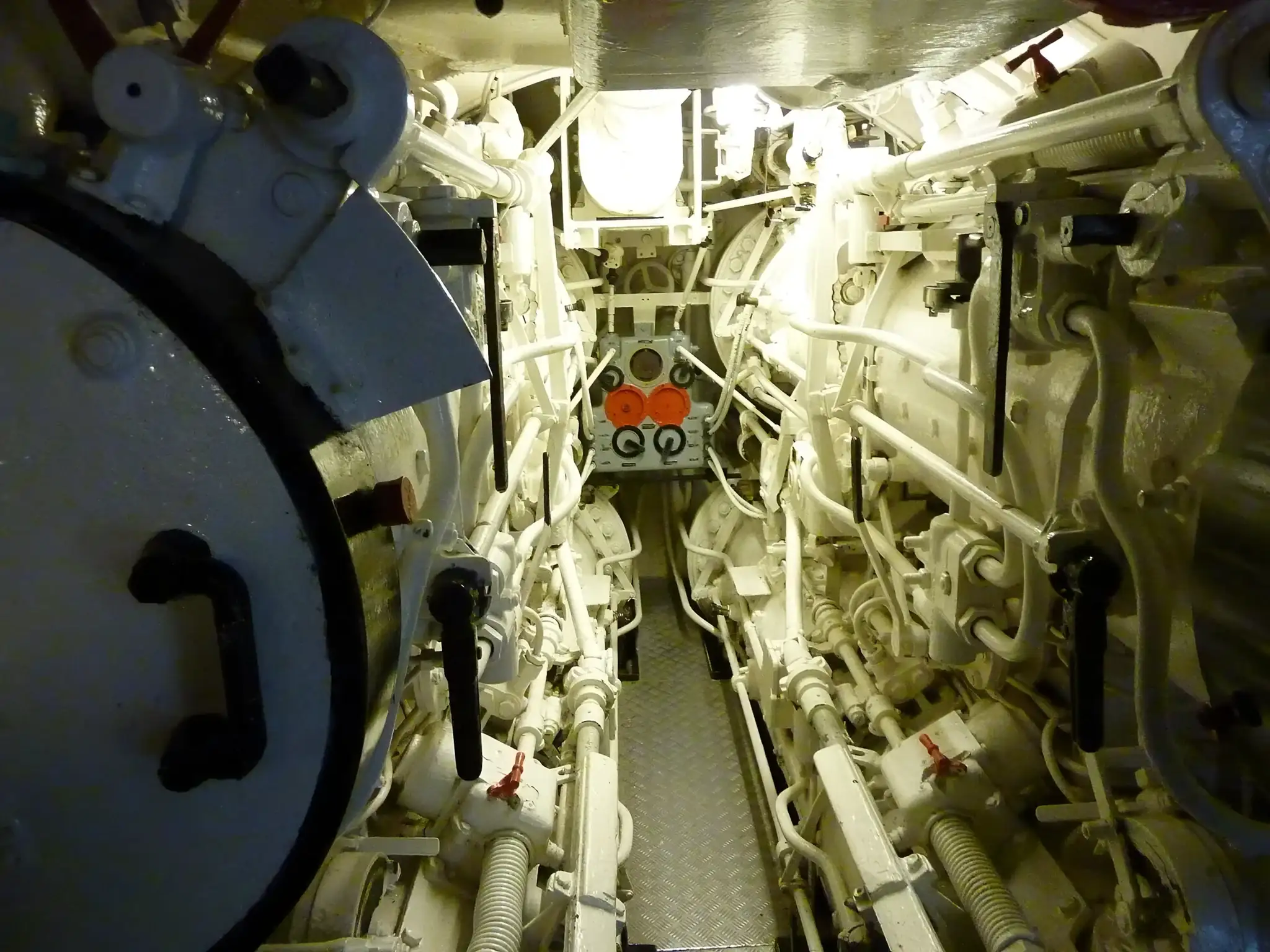
Yaroslav Shuraev / Wikimedia Commons; margins — FLUX 3 Klein for CAUSSA
A system outlives the hand that built it and carries forward exactly what was loaded in: a standard or a poison. The instrument can be honest; the calibration reveals the calibrator.
Contents
The Man with Nowhere to Hide
It started with a single conversation about the Kriegsmarine. The talk turned to submarines and how their commanders were chosen. I heard then that candidates for a boat were tested for psychological compatibility with the crew in a closed hull, and the thought lodged in me for a long time, because it carried a precise, unglamorous truth: fifty men, several months underwater, one commander whose equilibrium holds everyone. In a boat there is nowhere to step outside. Nowhere to hide fear, or anger, or an unjust order. The man standing in the central post is the only support everyone can see, and if he crumbles, everything around him crumbles. How do you recognize such a man in advance, still ashore, before the first patrol?

The question turned out to be wider than the navy. Any method of selecting people, in a headquarters, a firm, a school, a unit, writes down the values of whoever owns it, no matter what its manual claims. For those who build such a system and hold it in their hands, the question is what maturity must be present, so the thing that outlives them deserves to be carried forward.
The Method That Outlived Its Regime
Germany after the First World War found itself in a unique position. The Treaty of Versailles cut the army to a hundred thousand, and when men are few, a mistake in any one of them becomes too costly. A 2025 review in the Journal of Military and Veterans’ Health by Tuppin, Morrison, and Earl notes that Germany, because the Treaty of Versailles limited the size of its army, “developed a methodical approach to officer selection using psychological procedures.” During those years, the leading figure in German military psychology was Max Simoneit. The point of his method was that a man was placed in scenarios where his qualities revealed themselves, without being asked about them: the candidate acted, took responsibility or dodged it, held the group together or lost it. Profiling measured the whole man in action, where his account of himself no longer weighed anything.
The method outlived the regime that produced it. In 1942 Britain, drawing on the German work, created the War Office Selection Boards, selection commissions with group exercises, among them the leaderless discussion: several candidates receive a task, and observers watch who takes initiative and how, when no one has been ordered to lead. From this line grew the modern assessment centers that still sort candidates in the glass offices of corporations and on military proving grounds. Eighty years have passed, the Reich is gone, and the cog made for it keeps turning in peacetime machines.
Systems outlive their creators. That is not always good news.
The Commander Who Spoke Openly
Now to what happened inside that very system that supposedly knew how to measure a whole man. Oskar Kusch was born on April 6, 1918, rose to Kapitänleutnant, commanded U-154, and wore the Iron Cross First Class. In the officers’ wardroom he spoke against the regime where everyone could hear him. It was not weakness and not exhaustion; it was the position of a man who believed that honesty before the men you sail with is part of the service.
His first watch officer, Ulrich Abel, a lawyer whose training and loyalty were to the party, reported his commander up the flotilla chain on January 12, 1944. Dönitz’s September 1943 decree against criticism and complaints had been read aloud on the boat before that, and Abel stayed within the limits the system had just declared desirable. He later denied acting out of malice. The expert dismissed the charge of cowardice as groundless: a commander with combat patrols and an Iron Cross was not made of the material such charges stick to. But cowardice was never required.
On January 26, 1944, the court sentenced Kusch because he had undermined the armed forces and had listened to foreign radio broadcasts. The prosecutor requested a prison sentence of ten and a half years. Death was the sentence the court handed down. Dönitz refused clemency. Kusch was shot in Kiel on May 12, 1944; he was twenty-six. In 1996 he was rehabilitated, a single line in a certificate, fifty-two years later.
The instrument was sound. The psychological selection inherited from Simoneit could see a man in action, and it recognized in Kusch exactly what it was supposed to recognize: a steady commander his crew trusted. What was poisoned was the standard against which the instrument had been calibrated. Selection always measures someone against something, and that “something” is defined by the people who hold the system, while the methodologies merely record their choice. Kusch’s navy rewarded obedience, got obedience, and with it quiet wardrooms where no one spoke against anything anymore. The method writes down what the owner values.
The Methodology Said No Twice
US Army doctrine names the required quality directly. Willingness “to stand firm on values, principles, and convictions” is ADP 6-22’s definition of moral courage, which the manual concludes with “regardless of the consequences.” The same publication says change in deep character occurs only if deeply held values change. In the Holistic Health and Fitness program there are five domains of readiness: physical, mental, nutrition, sleep, and spiritual, and in the spiritual domain the concern is purpose and meaning in life without any denomination. Kusch had both courage and purpose. His judges had neither in sufficient supply to withstand their own system.
What remains is to understand why the question cannot be closed by the personal decency of a commander. In a boat, fifty men live in full view of one commander, and he can hold each of them with his own calm. An army corps, per ATP 3-92, is made up of “two to five divisions” plus numerous additional brigades, meaning its commander remains unseen by tens of thousands of its personnel. Mutual trust serves as the foundation for mission command in ADP 6-0, where the publication terms it “shared confidence between commanders, subordinates, and partners.” Trust at that scale cannot be transmitted through a handshake. A leader at scale cannot hold everyone himself; He must build a system that will hold in his absence, and because no other chance will come, his values have to be loaded into it in advance.
The Americans tried to do exactly that. In 2019 at Fort Knox they launched the Command Assessment Program pilot for selecting battalion commanders, and from 2020 the program ran army-wide: interviews, peer assessments where those who served beside a candidate speak about him, physical tests, and psychometric instruments. Each year, the number of lieutenant colonels passing through it was between 800 and 1,000, roughly. It was an honest instrument, heir to those same British boards of 1942, and it did its job: it found the unfit and said so in writing.
In December 2024, as Military.com reported, the Secretary of the Army fired four-star General Charles Hamilton after the inspector general established that the general had arranged for a subordinate, found unfit, an unprecedented second assessment that no one had ever received. She failed that one too. She was put on the command list regardless, with the Chief of Staff signing the step. The methodology said “no” twice. The people around her said “yes.”
In that same 2024, per Military.com, 54 percent of officers eligible for selection declined to take part, compared with an average of 40 percent since 2019. As the main reasons, the Army gave personal and family circumstances, and the report places that explanation next to any other reading. The question remains open: people leave a system when they see that decisions are made outside it anyway, or they are simply tired, and an honest text has no right to choose for them.
In January 2025 CAP was made a permanent program, a program of record, a status that in the US Army means stability for decades. On September 2, 2025, Military Times reported its closure and the return to the old Centralized Selection List. Six years of work, thousands of assessed officers, sound methodologies. The break was not in them.
Three Roles in Different Corps
Across all eighty years, three roles repeat in these two stories, and they are recognized by the act, because rank says nothing here. The one who spoke: Kusch in the wardroom, the CAP methodology that twice told the truth about an unfit candidate. The one who pressed: Abel with his denunciation in January 1944, the general with the second assessment in 2024. And the one who decided: Dönitz, who refused clemency, and the Chief of Staff, who signed the list. The roles are the same, the corps are different, and everyone who builds or holds a system for selecting people sooner or later finds himself in one of them, usually the third.
It becomes plain in the war’s fifth year: the absence of structure and chronic incompetence cut people down more effectively than enemy fire. We demand rigorous selection and ironclad training, yet the system of reproduction is paralyzed by stagnation. Digitalization and software race to close the deficit, but hardware does not fight in an initiative vacuum.
People are an exhaustible resource. They run out. Fatigue accumulates exponentially, while the managerial maturity that should have become the foundation of the army moves along some parallel path, detached from the front.
At this breaking point of illusions there is none: individual heroes and architects sooner or later burn out, break, or die. But when cold systems are built correctly, they carry the task through to the end and outlive their creators.
Simoneit’s methodology still sorts candidates in glass offices. The denunciations of the Abels still find their recipients. What we build will outlive us and carry forward what we loaded into it. A standard or a poison.
The resilience of a system begins with the maturity of its creator.


Worth reading
- Tuppin, Morrison, Earl — Psychological Assessment for Military Selection: Past, Present and Future Applications (JMVH 33:4, 2025)
- Oskar Kusch (Wikipedia)
- ADP 6-22 — Army Leadership and the Profession (US Army, 2019)
- ADP 6-0 — Mission Command (US Army, 2019)
- ATP 3-92 — Corps Operations (US Army, 2026)
- Holistic Health and Fitness: Spiritual Domain (US Army)
- Army cancels Command Assessment Program (Military Times, 2 Sep 2025)
- Army Secretary fires 4-star general who meddled in promotion of unfit subordinate (Military.com, 10 Dec 2024)
- More than half of senior Army officers are turning down command consideration (Military.com, 13 Dec 2024)
Citation
You may quote freely up to 300 characters, in quotation marks, with attribution to Pavlo Isaiev, "Systems Outlive Their Creators", caussa.blog.
© 2026 Pavlo Isaiev. The text is protected by copyright. Reprinting or translation is permitted only with the author's written consent and an active link to the original source.
New essays and studies by email
No spam, your address stays private: only new pieces as they come out. Unsubscribe anytime with one click.