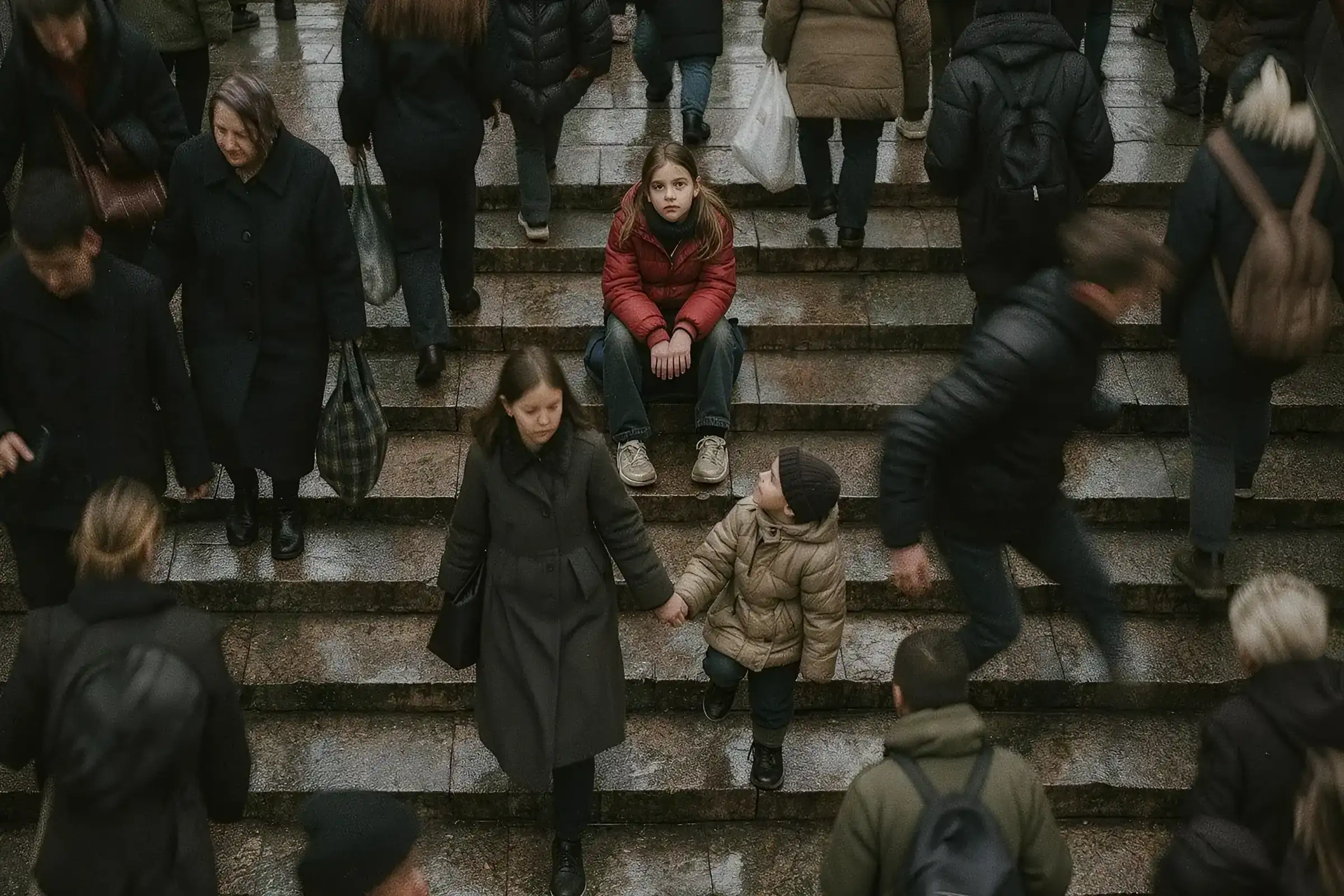
The Calendar of a Life
A grid of 4,680 weeks brings an entire life onto one screen. Small sums of books, summers and days with a mother make loss tangible, while the current week goes on filling itself.
FLUX-2-klein-4b for CAUSSA
Memory cannot reach the beginning of a life, and sight cannot reach its end. A grid of 4,680 weeks gives the missing sense a prosthesis: what has been lived and what remains possible appear together, and small sums turn waste into something the body can feel.
The school diary remained more vivid in memory than many textbooks. The left page held Monday, Tuesday and Wednesday, while Thursday, Friday and Saturday waited on the right. Between the ruled lines stood marks, homework and occasionally a teacher’s signature, and the whole week could be seen before it had even begun. In June the pages ran out, the notebook with its frayed corners stayed on the shelf, and in September another appeared, clean, with the same number of boxes for days still unknown. Childhood had at least this tangible edge: after the last lesson came summer, and after summer another diary was bought.
Now the calendar lives in the phone and wakes with the screen: notifications light up the date, reminders and other people’s meetings, and the weeks can be scrolled endlessly in either direction. The number of the year counts time from somebody else’s birth, the device knows today to the minute, but nowhere does it show which day this is in a life of one’s own. Life is a gift from one’s parents, and the easiest way to waste it is in days that pass unnoticed. Memory cannot reach its beginning, nor sight its end; each birthday adds another year, yet reveals nothing about the distance left. Why does life allow no sense of either its beginning or its end?
A whole life can fit on that same screen. In 2014, Tim Urban proposed a grid in which a year becomes a row of fifty-two cells and ninety such rows stand one beneath another: what has been lived and what remains possible can be seen together, without endless scrolling. The grid works like a prosthesis for a missing sense, because both edges are finally within sight. 4,680.
On the screen, the cells already lived begin to fill, row after row, faster than a finger can travel across the glass. The first remain almost soundless: memory does not hold their beginning, although that is where the body learned to walk and the world was a room and a few voices. Then come the hundreds of weeks of childhood, and what remains of them is a corridor, a kitchen door, somebody’s laughter, then school, a first job, moves from one home to another, ordinary evenings when the day ended without a single event worth recording. Hundreds have already been filled, yet the weeks that can be remembered from Monday to Sunday barely amount to a handful. The first blank cell brings the scrolling to a halt; suddenly, all that speed falls silent. This week.
From this cell, there is only one direction in which to look. With thirty-five years as the horizon and a yearly rate of one book, the shelf of unread books shrinks to thirty-five volumes; moreover, not every spine still looks as though its turn will arrive unaided. The same number of summers remains for the long days that seemed endless in childhood, though now summer can be over somewhere between a few errands. A small total changes the very sensation of loss: a spent week ceases to be a drop in an abyss. Behind the glass, only a small number of New Year’s Eves remain, and none of them suggests an endless supply.
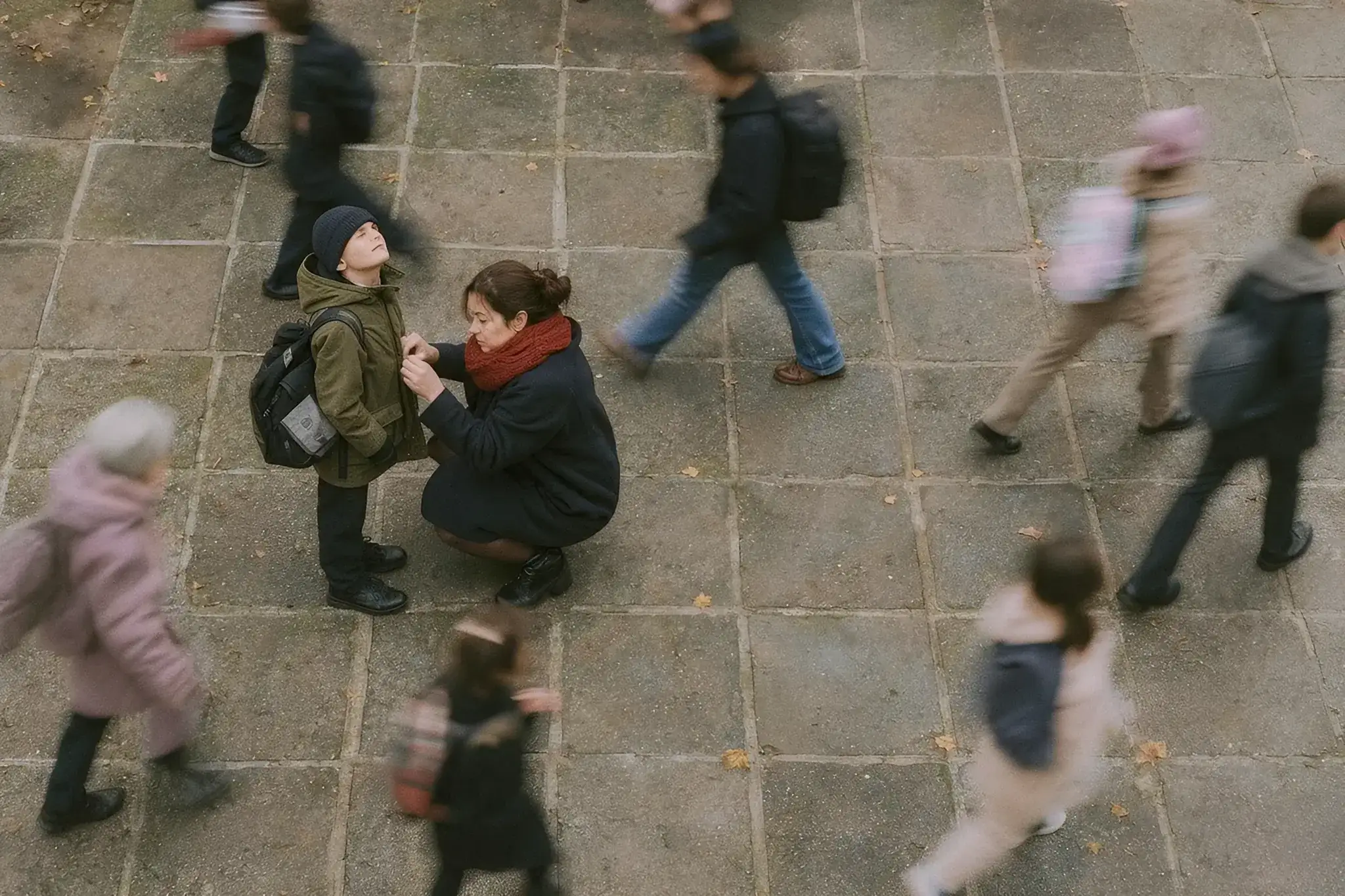
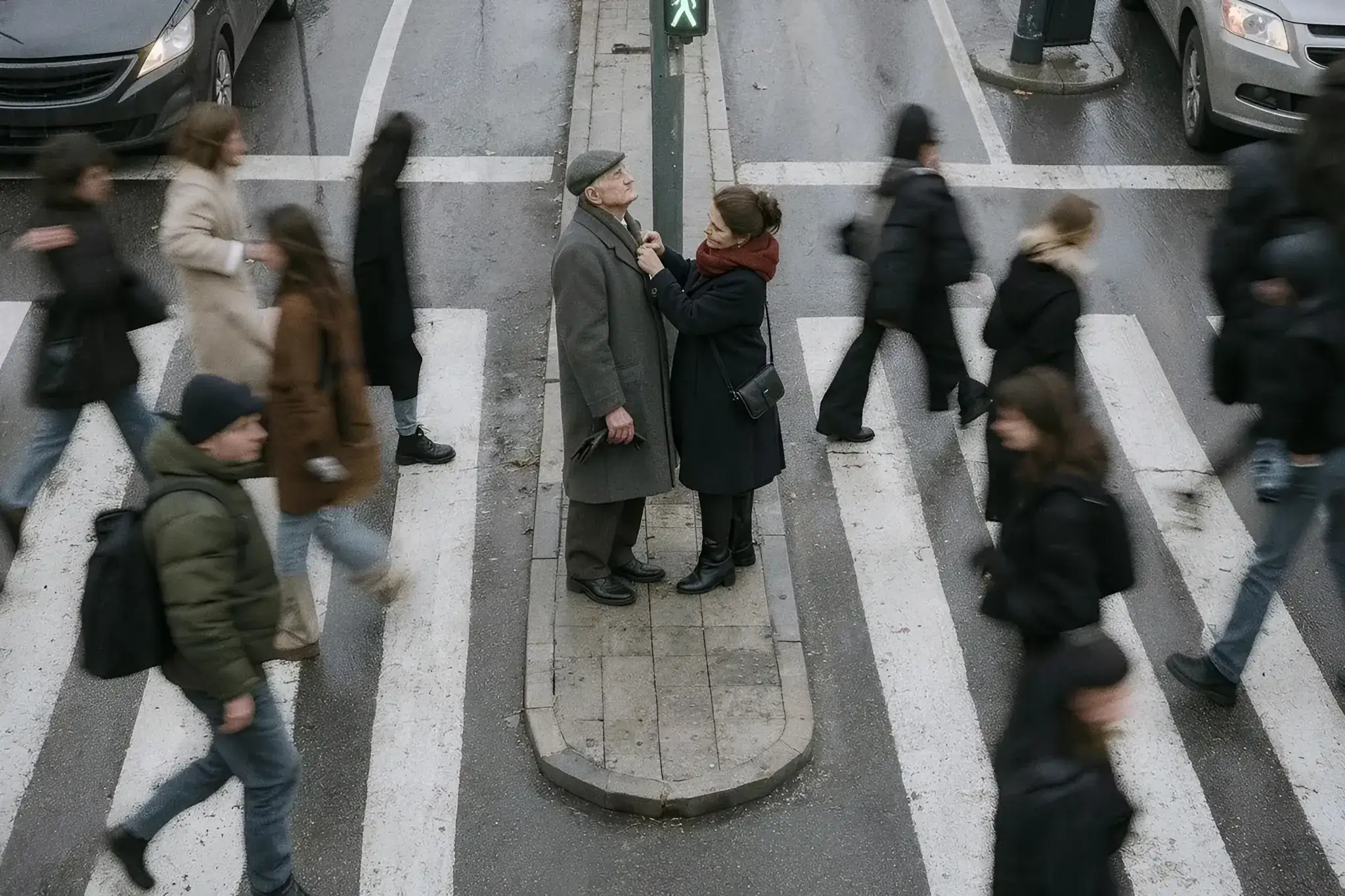
The count grows heavier when people take the place of things. In the same author’s next calculation, about 93 percent of all the time a person will spend face to face with their parents is already gone by the end of school; only a smaller portion remains, scattered among the ordinary days of adult life. A mother is fifty-five, and time with her amounts to ten days a year. On that same horizon, this is about 350 days. There are fewer of them than there were days in any single year of childhood, when a mother’s presence was so ordinary that it did not even need to be noticed.
Nor is the grid’s lower boundary fixed. Data from Ukraine’s Ministry of Social Policy give life expectancy at birth for Ukrainian men as 66.4 years in 2020 and 57.3 years in 2023; for women, the respective figures were 76.2 years and 70.9 years. War shortens plans to the next few days and, at the same time, alters the table from which forecasts will later be made. The women’s table has lost five rows, and in the men’s section nine have disappeared in three years.
That same edge moves far from war too. According to Eurostat figures for 2024, in a union at peace the highest life expectancy at birth was in the Community of Madrid, at 85.7 years, and the lowest in Severozapaden, in the north west of Bulgaria, at 73.9 years. Eurostat cites rising living standards, healthier lifestyles and better education as causes of longer life; only after statistics arrange them by region do they start to resemble fate. Twelve rows lie between them inside a single union.
The uniform cells also conceal the inequality of the lives themselves. Jeanne Calment took up smoking at twenty-one, quitting at one hundred and seventeen; even so, she lived for 122 years, 164 days, and her life extended thirty-two rows beyond the sheet’s edge. On 30 June 1905, when Einstein was twenty-six and occupied the twenty-seventh row in his personal grid, the journal received his paper on the electrodynamics of moving bodies. The paper on the connection between mass and energy reached the editors thirteen weeks later, on 27 September. The equal width of the cells says nothing about their weight. The cells between those dates held a new conception of space, time, mass and energy.
The strongest objection arises precisely here: a visible end can drive a person to grab, to rush, and to cram as much as possible into every cell. A 2004 study by social psychologists gave this objection real ground. Greed could be counted here: An envelope held raffle tickets for a gift certificate worth one hundred dollars, and the supply was limited to every participant; the researchers counted the number of tickets each one would take. After a brief abstract reminder of death, those most oriented toward money and status became greedier and took more.
Nobody chose the week, but it fills its cell regardless. In a separate part of the same study, the participants were asked to read a depiction of their own death: it showed a fire at night on an old building’s twentieth floor; open questions followed, one asking them to describe the lives they had lived up to that point. The gaze travelled back through what had already been lived, rather than receiving a brief signal of an end somewhere ahead. After this kind of review, people with the same focus on money behaved less selfishly and turned to intrinsic values. Two ways of approaching the end produced opposite results, and the grid of weeks could work in either direction.
A short horizon has its own truth. In a country living under attack, or where work is unsteady and access to education is unequal, plans reach only a week or a month, and the nearest cell remains within reach while rows further down cannot be planned at all. The empty rows on the sheet are an assumption about the time a person may still have. The sense of an edge is quiet here: the pursuit of more experiences gives way to attention to how the nearest week is already taking shape.
An ordinary week moves from Monday to Friday, an ordinary year from one holiday to the next, and between them it is easy to live for a long time without once seeing the sheet as a whole. The grid still glows on the screen as a person holds their thumb in the air above this week’s blank cell. The thumb hovers above the glass without pressing, and the person stops to look at what they really want for the next few days, what they are prepared to write here through the ordering of their own days, and what has so far found its way into the cell by itself, between reminders and other people’s business. The contents remain invisible; only the pause before the blank space can be seen.
The phone lies on the table beside an unfinished cup, the screen has already gone dark, and with it the rows, dates and filled portion have disappeared. Beneath the dark glass, the week remains the same length, and the sheet keeps its dimensions. The cell of this week remains behind the glass, invisible now, and still blank.


Worth reading
- Tim Urban, Your Life in Weeks, Wait But Why, 7 May 2014: a 90-year life as a grid of weeks, one row per year
- Tim Urban, The Tail End, Wait But Why, December 2015: by the end of high school about 93% of in-person time with parents is spent
- Guinness World Records, Oldest person ever: Jeanne Calment, 122 years 164 days; smoked from 21, quit at 117
- Annus mirabilis papers: «On the Electrodynamics of Moving Bodies» received 30 June 1905; «Does the Inertia of a Body Depend Upon Its Energy Content?» received 27 September 1905
- Telegraf, 13.04.2024, citing the Ministry of Social Policy and Pavlo Shevchuk (Ptoukha Institute of Demography): life expectancy at birth in Ukraine, men 66.4 (2020) to 57.3 (2023), women 76.2 to 70.9
- Cozzolino, Staples, Meyers, Samboceti, Greed, death, and values, Personality and Social Psychology Bulletin 30(3), 2004: greed counted in raffle tickets taken in a limited-resource task; mortality salience led highly extrinsic participants to greed; death reflection (a scenario of one's own death in a night fire, then open questions including a review of the life led) generated intrinsic, unselfish behaviour
- Eurostat, Mortality and life expectancy statistics (data for 2024, read 10.11.2026): highest regional life expectancy at birth in the EU, Comunidad de Madrid, 85.7 years; lowest, Severozapaden in Bulgaria, 73.9 years; among the causes of longer life: rising living standards, improved lifestyles, better education
Citation
You may quote freely up to 300 characters, in quotation marks, with attribution to Pavlo Isaiev, "The Calendar of a Life", caussa.blog.
© 2026 Pavlo Isaiev. The text is protected by copyright. Reprinting or translation is permitted only with the author's written consent and an active link to the original source.
New essays and studies by email
No spam, your address stays private: only new pieces as they come out. Unsubscribe anytime with one click.