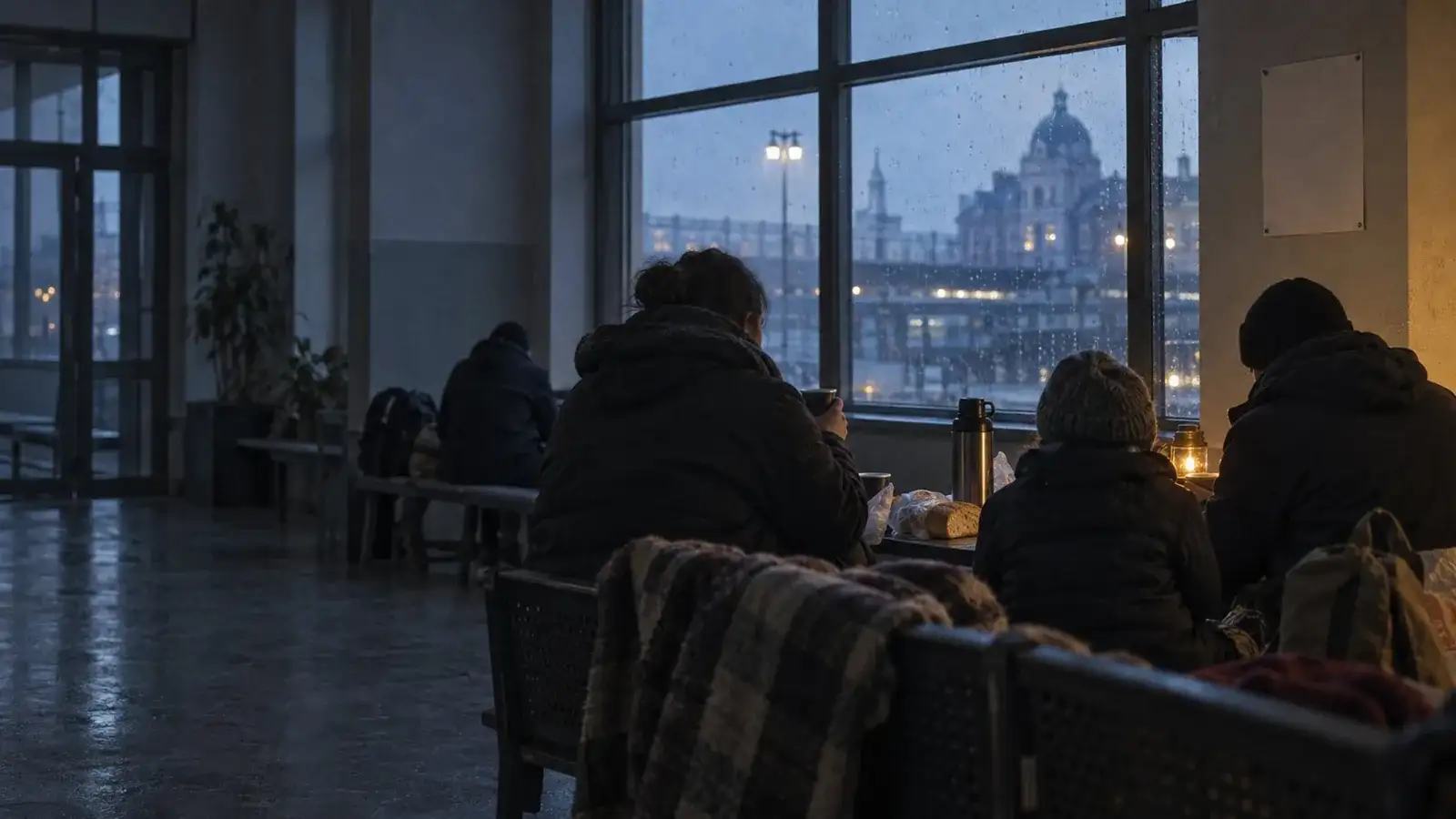
The Fracture of Survival
A country that began the war in a single honest surge is now silently forming a queue to decide whose survival deserves respect. The fracture is still liquid, but liquid has a way of hardening for decades.
CAUSSA · © 2026
Contents
- Contracts. An agreement no one signed
- The scale. Seven points between family and border
- The search. Papers: a million and a half
- The veteran. A canon that wounds its own
- Latency. Four hundred and one voices
- The mirror. The question that was put to those who emerged
- Jerusalem. Witnesses against the nickname
- Mechanics. What moves the liquid before it sets
- The door. A line that holds
In a front-line city, on the door of an apartment building entrance, someone wrote in chalk: “People live here.” Not a surname, not an apartment number, not a request for the utility workers. The line sits on a door that opens dozens of times a day, and everyone who passes reads it their own way. Some see a notice for those who left and might return. Others see a note for the neighbor upstairs who talks too loudly about those who stayed under occupation. Still others see simply a fact that suddenly requires confirmation.
Rain washes the chalk away, and someone restores the sentence to the door, a sentence that a few years ago would have been meaningless. People live in apartment building entrances; that is what entrances are for. But in the autumn of 2026, five years after the full-scale war began on February 24, 2022, this sentence reads as an argument within a dispute that no one is conducting out loud.
The dispute has its numbers. In August 2026, Rating Group asked two thousand people what they call this war. Fifty-one percent answered: a war of liberation fought so the state could exist and remain independent. Thirty-five: a conflict among great powers over geopolitics, in which Ukraine is a hostage. Eleven: exhausting and self-destructive.1 Three answers about the same war, three different countries within the same borders. In that same survey, history and the future were called not timely now by 43 percent, because surviving and preserving the state is the task. And 98 percent view the soldiers of the current army positively.
By 2026, 82 percent supported recognizing the OUN-UPA as independence fighters, compared with 45 percent in 2019. Society reads the past differently. A people defending itself searches the past for those who defended before them. At the same time, in October 2026, 62 percent of Rating Group respondents said that no one is winning.2 No one is winning; one must hold on anyway. Everything that follows grows from this.
Winning the war is possible, yet the country may still not be reassembled afterward. This thought is not my invention and not a prophecy; it is the working hypothesis of this text, and I will test it against numbers already in print and against two historical mirrors already standing before us, whether we wish to look into them or not. The fracture is still liquid. It can still be stirred. The only question is whether we see it at all.
Contracts. An agreement no one signed
In a society at war for the fifth year, two contracts operate that exist in no law. The first measures a person by contribution: how many days on position, how many drones bought, how much blood donated, how many years given. The second measures a person by preserved life: she survived, she evacuated the children, she waited it out, she betrayed no one. Both contracts are honest. Each on its own is a basis for respect. Trouble begins where they meet and start competing for the same person.
Forty-three percent became a postponement of history and the future: first survive, then count. Indifference postpones nothing for itself. But postponement has a way of accumulating interest. Questions deferred for later do not disappear; they temporarily shift into the sphere of everyday judgments, where mood resolves them instead of discussion. The one who left fled. The one who stayed under occupation waited. The one hiding from the draft summons is called a traitor. Judgments are born faster than facts, and each is a small sentence passed without a court.
Aleida Assmann, in her 2006 book Der lange Schatten der Vergangenheit, noted something the German language holds in a single word while English splits it into two. Opfer means both the victim-as-offering, given for a higher purpose as an act, and the victim-as-sufferer, who endured helplessly.17 The first meaning receives a monument. The second receives a question. A culture in need of pride finds it convenient to look at the first victim and avert its eyes from the second, because the second proves nothing except that the world was cruel and the human being was weak.
I dwell on this word deliberately, because the entire anatomy of the fracture ahead rests on it. When a society begins sorting suffering into worthy and unworthy, it invents nothing new; it simply applies an old linguistic trap to living people. The victim-as-offering has a name on a memorial. The victim-as-sufferer has to explain why she is still alive.
The scale. Seven points between family and border
Using the Bogardus scale, KIIS measured social distance, where one means readiness to accept a person into one’s family and seven means not letting them into Ukraine at all. Distance to internally displaced persons stands at 3.20; they are ready to admit them to their circle in nearly 58 percent of cases. To refugees abroad the distance is 3.66. For Russian-speaking citizens of Ukraine, the figure is 3.73. For Ukrainians who came under occupation after February 24, 2022, the figure is 3.97. 40.7 percent are ready to accept them into their circle. To citizens who are ethnically Russian it is 4.32.3
Let us pause on one pair. IDPs and a person under occupation score 3.20 against 3.97. These citizens are identical; only the line where the front passed separates them. One managed to leave before the city came under the flag of a foreign army; the other did not leave: either did not make it in time, or had nowhere to go, or stayed with a sick mother. They are judged by geography they never chose. A difference of 0.77 points on a seven-point scale marks out an entire class of people who, after the war, will have to prove they did not collaborate.
Oleksiy Antypovych, head of Rating Group, in a conversation with LB.ua in February 2025, named the figures behind these decimals: At the end of 2024, 20 percent of those living on government-controlled territory felt coldly toward Ukrainians under occupation; likewise, 30 percent of those who stayed felt just as coldly toward those who went abroad.5 The South and East account for about 60 percent of those who ended up abroad, and Russian was their daily language on leaving, their cultural background Soviet. The coldness runs both ways.
Trust in most people, according to OPORA’s April 2025 study, stands at 21 percent among those in Ukraine and 18 percent among those abroad.6 I read these numbers without accusation, because I recognize myself in them: each of us carries a silent list of whom we respect and whom we condemn, and this list existed before the war, for the war merely allowed us to say it aloud. But there is a line beyond which the list ceases to be a private opinion and becomes a social mechanism. We too often forgive survival only when we see that the person survived not for themselves. One’s own life, by itself, is no longer sufficient grounds. I write this sentence about all of us, and about myself too.
The search. Papers: a million and a half
Hromadske reported on August 17, 2026, citing acting National Police chief Maksym Tsutskiridze: During 2026, the police received more than one million five hundred thousand requests from territorial recruitment centers to track down citizens who were dodging mobilization.7 The source counts requests; how many people stand behind them, the article does not say. One person may stand behind several requests, and yet the scale of the phenomenon is visible without clarification: searching for fellow citizens has become one of the state’s routine functions.
The security problem is real, and it must be acknowledged fully before proceeding. The army needs people, the front holds on people, and whoever consciously evades shifts their share onto someone else’s shoulders. A state that does not search for evaders betrays those who serve. All of this is true. And precisely because it is true, it is worth looking at what the anger directed at evaders turns into.
In December 2024, Rating Group, together with the Ukrainian Veterans Foundation, measured trust: 67 percent do not trust territorial recruitment center servicemembers, 29 percent do; 94 percent trust Armed Forces servicemembers at the front.8 Trust is what the survey measures, and it gives no reasons. But the proximity of these numbers speaks of a deformation found in no statute. Anger seeks what is reachable. The real enemy is beyond the front line, unreachable; the evader is in the neighboring entrance, and the recruitment center is on the street. The mechanism of inverting the enemy is old: when the real threat lies outside reach, rage finds the one at hand.
Readiness to endure the war as long as necessary, according to KIIS data in October 2026, is 62 percent.4 Looking at each region separately, compared with September: the West the west rose from 61 to 69 percent; The south fell from 55 to 50. the east fell from 56 to 47. Endurance across the country is uneven.
Stigma placed on an entire category works cheaply: no need to sort out who evades out of fear, who out of cynicism, who because of a sick child at home. One word covers them all. And everyone it has covered will return to this country after the war carrying a residue that no chalk can wash off.
The veteran. A canon that wounds its own
A GMF report from April 2025 records over 1.2 million veterans; what ministries project is five to six million.9 The first have already passed through the front; the second have yet to pass through it. The document citing both figures is titled “Reintegrating Ukraine’s Veterans.”
Trust in veterans, measured in December 2024: Among ATO veterans fighting again the figure stands at 96 percent, and it reaches 88 among ATO veterans from 2014–2021. The image of the veteran in Ukrainian media in the same survey: 64 percent consider it “mostly positive,” 20 “rather neutral,” 4 negative. The heroic canon works. But the canon has a reverse side, visible in another line of the same study.
Those who believe the state is fulfilling its obligations to veterans amount to: The figures are: In August 2022 it was 69 percent, in January 2023 53, in September 2023 33, in March 2024 25, and in December 2024 25. Five points, one line downward. His belief that the state will keep its word to him is declining. The canon that exalts simultaneously wounds those for whom it was created: the hero in it is always tireless, calm, unbroken, convenient. The hero must match the image; the image was invented without him.
Five to six million people with front-line experience will return to a society that has already learned to sort. They will be sorted too. The hierarchy of survival will not stop at demobilization; after the war it will step into civilian life, where no filter has yet been built for it.
Latency. Four hundred and one voices
On June 19, 2026, the Prosecutor General’s Office announced via Radio Svoboda and Ukrainska Pravda: Documented are 401 cases of sexual violence tied to conflict against civilians; among those affected are 151 men and 250 women, including one boy and 23 girls. By region: Zaporizhzhia 33, Kyiv region 60, Donetsk region 92, Kharkiv region 48, Kherson region 124.10 Suspicion notices were served on 116 Russian servicemembers; 64 indictments covering 81 individuals were sent to court; 148 cases were solved; 19 verdicts were handed down against 26 individuals, all of them prison sentences.11
What the number 401 counts is individuals who dared to speak. It does not count the crimes themselves. Men make up over a third of the complainants; each of them overcame fear of the investigation and another fear, of their own surroundings, where a man who speaks of such things risks receiving, instead of sympathy, a new status in someone’s silent list. How many people did not speak is something no one knows. Latency hides this part of the crime from statistics, because its carriers decided silence was cheaper.
Here is where the hierarchy of survival shows its price most sharply. A society that sorts suffering into worthy and unworthy creates a tax on truth: speak, and you receive a stigma along with support. Four hundred and one people paid this tax. The rest calculate it daily and, for now, choose silence. And the silence accumulated in thousands of families will, after the war, become the material from which residue forms where memory should have formed.
The mirror. The question that was put to those who emerged
On January 1, 1942, in the Vilna Ghetto, Abba Kovner proclaimed a manifesto in which the phrase about the flock going to slaughter was a call to armed resistance.12 And then what happens to strong words happened to this phrase: it was torn from its context and began to be used against those it was never aimed at.
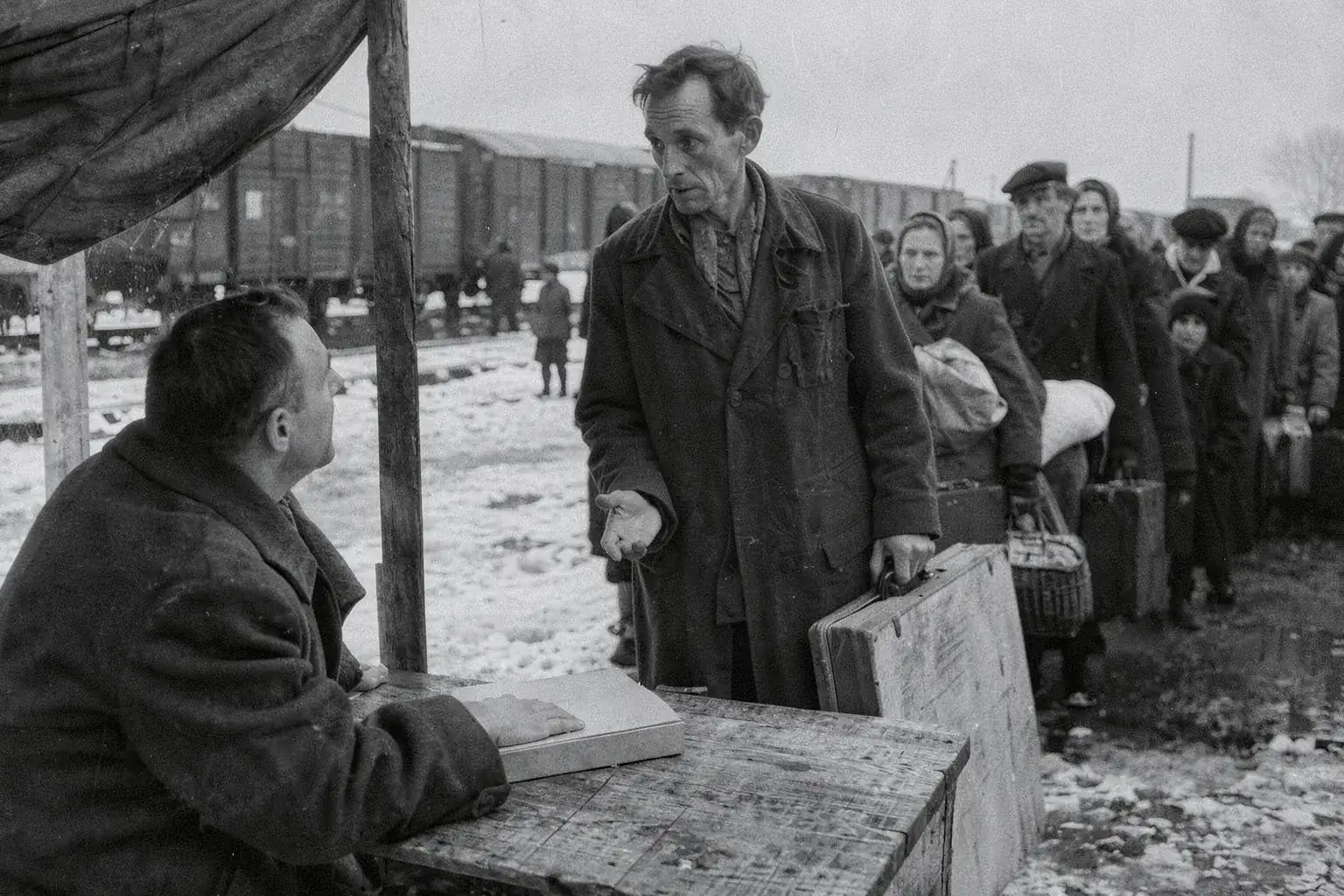
Daniel Gordis retells Tommy Lapid’s recollection from his son Yair Lapid’s book Memories After My Death: In it, veterans of the Yishuv asked those who had come out of the camps two questions: “Why didn’t you fight back?” and “Why did you go like sheep to the slaughter?” In the dining hall of a country built as a refuge, a survivor of Auschwitz, his arm bearing a blue number, worked as a cook; the old-timers called him “Soap,” a nickname that, as Lapid put it, came from “a twisted play on the famed Nazi plan to use Jewish body fat to make soap.” A man who had passed through a death factory was given a kitchen nickname made from his own suffering.14
The Knesset passed the law on Nazis and their collaborators on August 1, 1950, and during the 1950s Jewish functionaries from camps and ghettos were tried under it: kapos, ghetto police, members of the Judenräte.13 About forty trials took place between 1951 and 1972. Real collaborators were tried, and the guilt of many was real. A country that had won its war of independence and had every moral right to be proud of itself spent several years sorting its own rescued. Into worthy and unworthy.
The other side of this mirror stands further east. According to V. Zemskov’s data, by March 1, 1946, 4,199,488 repatriated Soviet citizens had passed through screening; of them, 608,095, or 14.48 percent, were sent to labor battalions; the NKVD received 272,867 people, a figure that is 6.50 percent of all returnees, whether prisoners of war or civilians; being handed over to the NKVD carries a status separate from captivity.16 The victorious state received its own people back through filtration, and suspicion became a permanent address for hundreds of thousands. Two victorious countries, two different systems, and in both the first word to their own was a question.
Jerusalem. Witnesses against the nickname
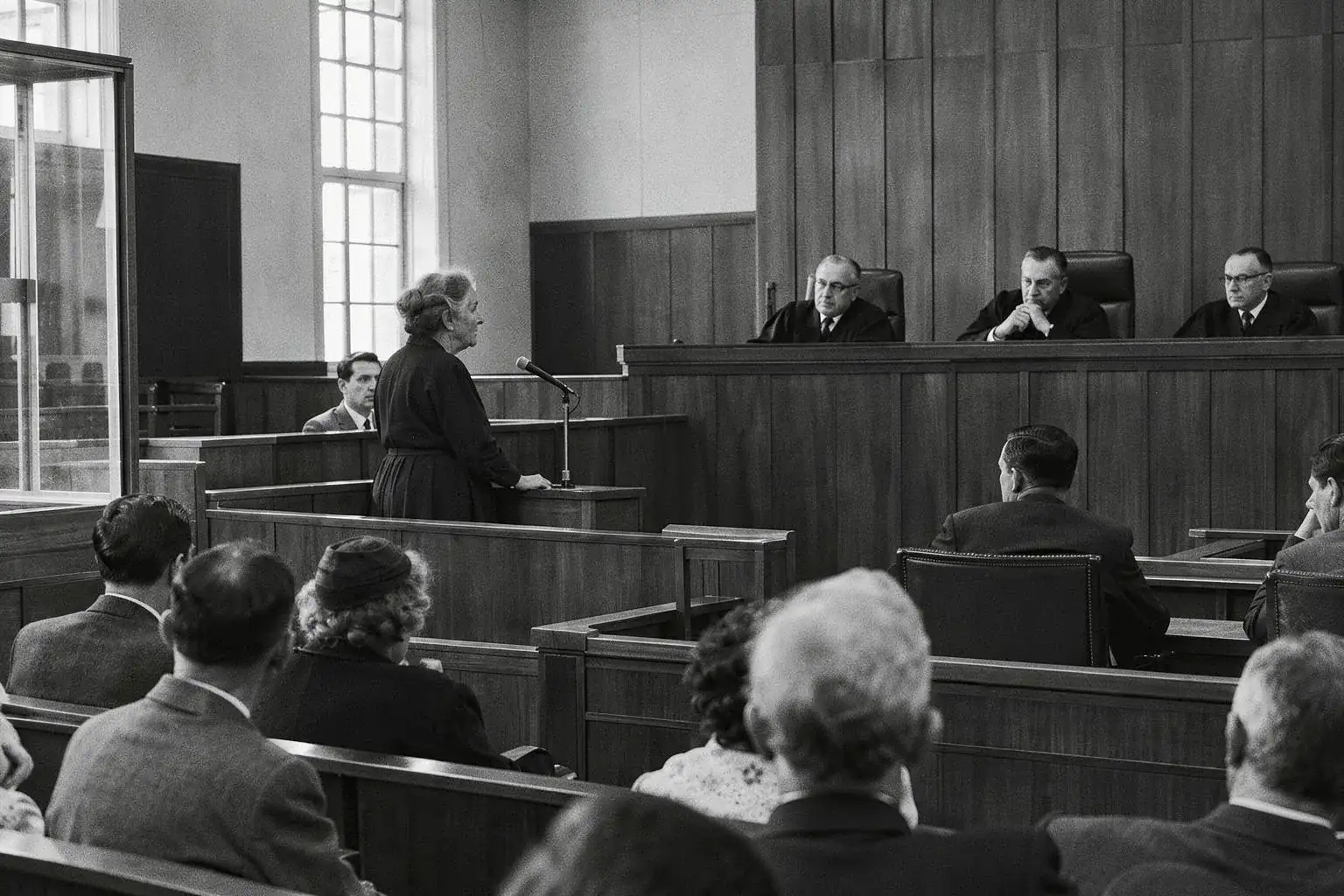
On April 11, 1961, the trial of Adolf Eichmann began in Jerusalem. Prosecutor Gideon Hausner built the prosecution on the testimony of survivors.15 For months, until August 15, the country listened on the radio to people who in the 1950s had been asked why they went like sheep. Now these same people stood at the witness stand. Wikipedia records the testimony of Zivia Lubetkin, who spoke of the armed uprising in the Warsaw Ghetto: “countered any insinuation that Jews went ‘like sheep to slaughter.’”
I pause at this stand for a long time, because here happened what this text was written for. They were not asked how they fought. They were asked why they did not resist. For years the country carried this question inside itself. The 1961 trial did not annul the question by law; it allowed those to whom it was addressed to answer, before the entire country, one by one. And the country began to gather around their testimonies, for the defendant in the glass booth was no longer the center of that attention.
Those who in the 1950s were called by a nickname in the dining hall took the stand in 1961. How much such a passage costs, and whether an Eichmann is strictly required for it, history does not say.
Mechanics. What moves the liquid before it sets
I do not believe in calls for unity, because unity proclaimed from above demands silence about the fracture, and beneath it the fracture does not seal over. I believe in mechanisms, and there are not many of them.
Memory that holds both meanings of the word “victim.” A memorial to the hero and a space for the one who endured helplessly do not compete; they stand side by side, and a culture that can hold monument and testimony together does not force the living to choose between them.
Whether the state’s language can do without labels, when the word “evader” in a document works differently from the phrase “a citizen evading mobilization,” because the first is a status and the second a description of an act, and a status remains for life, while an act can be changed. The language of the state is the mold into which the fracture is poured; A label found in a law or news report is already nearly a sentence, and no later process resembling the Jerusalem one will be able to remove it.
The law must weigh acts, and only acts: a person is tried for what they did, with evidence, with a lawyer, with statute of limitations; where the front line found them and what language they thought in as a child does not go on the scales.
Hausner in 1961 did one thing that deserves to be named separately: he gave the stand to those who had been through it. A country that now knows how to sort them will receive five to six million returnees, and they will start sorting it in return; for that to be possible, the infrastructure requires a truthful picture of the veteran and a truthful stance toward the survivor. In war you quickly learn a simple truth: borders are held by units, but a country is held by connections between people. A connection does not hold on 21 percent trust. It holds on the fact that a person who survived is not forced to explain it.
The door. A line that holds
The chalk inscription on the entrance door in the front-line city gets washed away by rains, and someone renews it again. When I began this text, the inscription seemed to me a report; now it seems a demand, proceeding from the very way we look at one another, before any question of who left and who stayed. People live in apartment building entrances, in camps, in ghettos, in filtration camps, in lines at recruitment centers and in lines at the border, and the question is always the same: whether we recognize them as people before they have explained exactly how they survived.
Israel gathered itself around testimony after years and one trial. The Soviet Union distributed its returnees among battalions and personnel files. Both countries won their wars. One reassembled itself after the war.
Winning the war is possible, yet the country may still not be reassembled afterward. Such cases occur in history more often than one would like. The fracture is still liquid: 3.20 against 3.97 is not yet an abyss, 25 percent faith is not yet zero, 43 percent postponement is not yet refusal. But liquid sets imperceptibly, and the day it turns solid will not be marked in any poll.
The next time you catch yourself silently weighing someone’s survival, the same door will stand before you again, with the inscription someone had to restore after every rain.


Worth reading
- Rating Group — суспільно-політичні настрої, ідентичність, 4–9 серпня 2026 (CATI, 2000): 51% / 35% / 11%; 43% «не на часі»; 98%; ОУН-УПА 82% (45% у 2019)
- Rating Group — суспільно-політичні настрої, 3–5 жовтня 2026 (CATI, 1000): 62% — не перемагає ніхто
- KIIS — ставлення до біженців, ВПО, людей в окупації (шкала Богардуса): 3,66 / 3,20 / 3,97 / 3,73 / 4,32
- KIIS через Телеграф — готовність терпіти війну, жовтень 2026: 62%; захід 69%, південь 55→50%, схід 56→47%
- LB.ua — Олексій Антипович (Rating Group), лютий 2025: 20% холодно до людей в окупації, 30% до тих, хто виїхав; ~60% виїжджих з Півдня і Сходу
- ОПОРА — «Соціальна згуртованість в українському суспільстві» (Rating Online, 1–5 квітня 2025): довіряють більшості 21% в Україні, 18% за кордоном
- Громадське — 1,5 млн звернень ТЦК до поліції щодо розшуку у 2026 році
- Rating Group / УВФ — образ ветеранів, 5–6 грудня 2024: ТЦК не довіряють 67%; ЗСУ 94%; ветерани АТО 96% / 88%; ЗМІ 64% позитивний; зобов'язання держави 69→53→33→25→25%
- GMF — «Reintegrating Ukraine's Veterans» (квітень 2025): понад 1,2 млн ветеранів; прогноз 5–6 млн
- Українська правда. Життя — 401 випадок СНПК; області: Херсонщина 124, Донеччина 92, Київщина 60, Харківщина 48, Запоріжжя 33
- Радіо Свобода — генпрокурор Кравченко, 19 червня 2026: 401 факт; 116 підозр; 64 акти щодо 81 особи; 148 розкрито; 19 вироків щодо 26 осіб
- Wikipedia — «Like sheep to the slaughter» (Абба Ковнер, маніфест 1 січня 1942)
- Wikipedia — «Nazis and Nazi Collaborators (Punishment) Law» (Кнесет, 1 серпня 1950; близько сорока процесів 1951–1972)
- Daniel Gordis on Tommy Lapid's memory of an Auschwitz survivor
- Wikipedia — «Eichmann trial» (11 квітня – 15 серпня 1961, прокурор Гідеон Гаузнер, свідчення тих, хто вижив)
- В. Земсков — «Репатриация перемещённых советских граждан» (на 1 березня 1946: 4 199 488 перевірених; 608 095 у робочі батальйони; 272 867 до НКВС)
- Wikipedia (de) — «Der lange Schatten der Vergangenheit» (Aleida Assmann, 2006: Opfer — жертва-дар і жертва-постраждалий)
Citation
You may quote freely — up to 300 characters, in quotation marks, with attribution to: Pavlo Isaiev, "The Fracture of Survival", caussa.blog.
© 2026 Pavlo Isaiev. The text is protected by copyright. Reprinting or translation is permitted only with the author's written consent and an active link to the original source.
New essays and studies by email
No spam, your address stays private: only new pieces as they come out. Unsubscribe anytime with one click.